
Mission city likely to be approved to National Register
San Juan Bautista’s Third Street commercial district, with its
origins dating back to the 1830s, is one step away from being
included in the National Register of Historic Places.
The State Historic Resources Commission in November approved the
district’s nomination and forwarded the recommendation to the
National Park Service for final approval. San Juan City Planner
Matthew Sundt, who helped coordinate the nomination process along
with a consulting firm, said the process should be complete within
45 days.
Mission city likely to be approved to National Register
San Juan Bautista’s Third Street commercial district, with its origins dating back to the 1830s, is one step away from being included in the National Register of Historic Places.
The State Historic Resources Commission in November approved the district’s nomination and forwarded the recommendation to the National Park Service for final approval. San Juan City Planner Matthew Sundt, who helped coordinate the nomination process along with a consulting firm, said the process should be complete within 45 days.
“As far as I’m concerned, it’s approved,” he said.
Designation on the register of historic places could help raise the profile of the Mission City, which relies heavily on tourist traffic to support its economy of shops and restaurants.
“We can fly a banner saying ‘National Historic Register District’ and we might get a little more interest from tourists,” Sundt said. “Maybe it’ll mean a few more RV’s coming to town. We can only assume there will be some amount of benefit. It’ll increase our visibility.”
State Historian Cynthia Toffelmier said that federal approval of the historic designation recommendation is not automatic, but “it is to the advantage of the nominee” to have the state’s endorsement.
In conjunction with the consultant, Galvin Preservation Associates, a team of San Juan residents devoted numerous hours to researching the history of the town’s main business district and were crucial to the historic designation effort, Sundt said.
“They went into county and city records, checking libraries and local historical society files, along with the county assessor’s office,” he said. “They spent hundreds of hours over a year, with most of the volunteer work effort concentrated in a four- to six-month period.”
One of those volunteers, Sheila Prader, said the city has a number of structures “that are really very good examples of a cross-section of history. You can actually see how the town developed by researching its buildings.”
Prader, who is president of San Juan’s Historical Society, said there are “very few places anywhere any more that have a sense of place about them like San Juan does. Historic buildings are considered a public good in California. There’s an inherent benefit to preserving them.”
Toffelmier, the state historian, said that San Juan’s Third Street commercial district qualifies for two of the four criteria used to determine inclusion in the National Registry of Historic Places: historic trends and patterns and architecture or property type.
“The area is significant of Criterion A because it represents the commercial development of San Juan Bautista between 1849 and 1938,” she said.
The city’s nomination notes that when compared to towns developed during a similar time period, San Juan “is one of the few, if not the only one, that retains its historic rural character. The town also does not have the usual post-World War II suburban growth associated with these other communities,” such as San Francisco, San Diego, Santa Barbara, San Juan Capistrano and Santa Cruz.
The commercial district meets Criterion C “for having a large number of good examples of commercial architectural styles that reflect different eras” in the city’s history, according to the nomination.
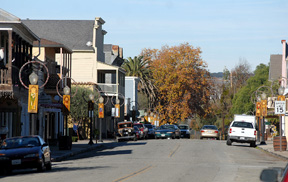
Third Street, which runs north to south through San Juan, consists of 26 historic buildings constructed between 1834 and the 1930s. The two-lane street was paved for the first time in the 1920s, roughly a decade after the sidewalk areas were paved with concrete from the cement plant operating at the mouth of the San Juan Canyon.
Located one block south of San Juan’s Mission and state historic park complex, Third Street is a popular destination for visitors who stroll the historic storefronts or eat in the various restaurants that line the thoroughfare. Iron ties formerly used to tie up horses, can still be found along the street, which is illuminated at night by circa-1910s metal lamp posts that were refurbished and reinstalled this year.
The street’s buildings range from Spanish colonial style adobe to Monterey Colonial and Carpenter Italianate, according to the city’s historic registry application.
The most common style of architecture along the route, however, is the Western False Front, a modest, single-wall type of construction that was popular in remote areas like San Juan Bautista, where building materials and skilled architects and builders were scarce.
Two buildings in the Third Street commercial district are already listed on the National Register of Historic Places: the Casa Juan de Anza Adobe at the corner of Third and Franklin streets, which was built in 1834, and The Rozas House at 31 Polk St., a former boarding house built in 1856.
“San Juan Bautista still gives visitors a feeling of having stepped back in time into a rural mission town from another area,” the city’s historic designation application states. “The chickens and roosters that freely roam the street add to this atmosphere. Therefore, Third Street retains its historic feeling and association.”
San Juan being bypassed by two large transportation projects – the Southern Pacific Railroad in 1870 and Hwy. 101 in 1930 – has contributed to it remaining a sleepy enclave that retains much of its historic charm.
The city’s historic registry nomination points out that “this has resulted in inadvertently creating a rich collection of historic buildings,” relatively untouched by modernization – at least on their exteriors. It has also meant a lack of adequate revenue for maintenance many of the buildings along Third Street and throughout the town as a whole, the report states.
“Even after over 150 years, Third Street remains [part of] a small rural town with its historic vernacular buildings largely intact, harkening back to what we think of today as being a quieter and simpler era,” the nomination reads.
City Councilman Rick Edge said the city being officially recognized on the National Historic Register of Historic Places would be “great” for the town.
“It will help get attention for our historic downtown and attract more attention from tourists,” he said. “It was an awful lot of work by a lot of people.”
What’s more, income-producing properties within a nationally-registered district are eligible for a 20 percent federal rehabilitation tax credit, Toffelmier said. Any approved rehabilitation of eligible properties would be monitored to make sure it meets the standards set by the state to retain the historic character of the site.