

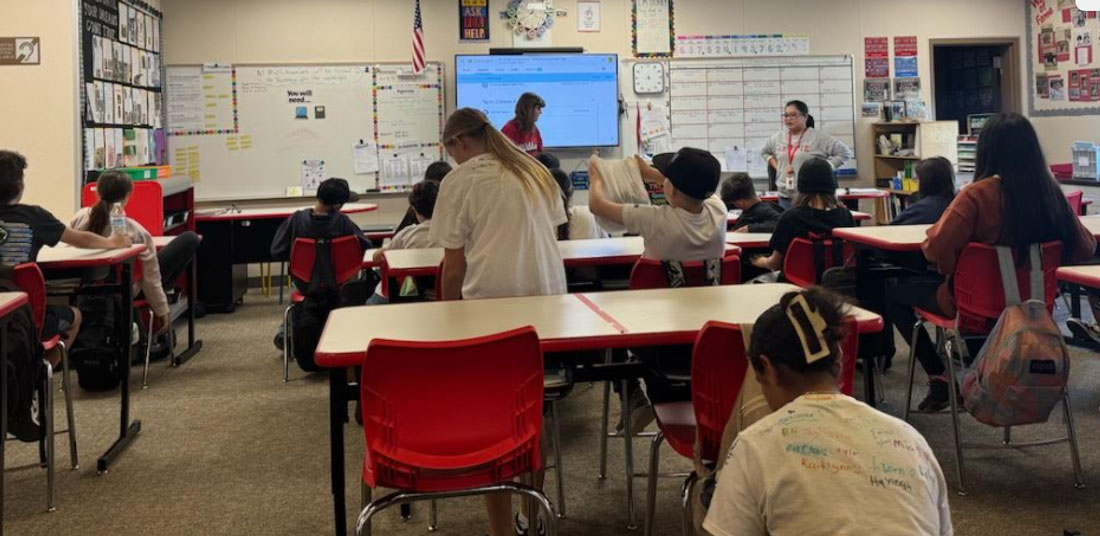
The Hollister School District has seen positive impacts from an increased use of co-teaching in classrooms that involves combining special education students with general education peers.
A pilot program at Rancho Santana School has really underscored gains from blending students who have been largely separated in the past. The district now has co-teaching models in place at Rancho Santana, Ladd Lane, Maze, Rancho San Justo and Calaveras.
“Co-teaching is an opportunity for general education teachers and special education teachers to work together to support the needs of all the students in their classrooms,” said Dr. Gabriel Gutierrez, Director of Special Education for the District.
The process started with the district, site administrators and parents brainstorming ideas about expanding inclusive practices. This collaboration was so effective that this school year, the Special Education Department expanded meetings with parents holding 15 meetings—referred to as “Partnering with Parents”—held at all of the sites.
Rancho Santana was a pilot of sorts with regard to a learning center model integrated with the co-teaching model. This enables students in a self-contained classroom to receive instruction with general education peers in a less-restrictive environment, with the learning center connected to their program to support small-group learning and focused support on IEP goals.
Parents at that site wanted to find ways to keep their middle school students at their home school and discussed preferences for self-contained classrooms.
Given that the site does not have the capacity for that due to space, the collaboration evolved to find a creative solution. There was a realization that the school could provide for more inclusive environments through co-teaching, which has spurred benefits for all students.
Gutierrez said an increased use of the co-teaching model and extending that opportunity to students in self-contained classrooms has led to improvements in student achievement, socialization and confidence, “Not only with students with exceptional needs, but also the general education students.”
He said it has provided a better level of understanding and empathy among peers.
Gutierrez noted how the state wants districts to show increases in the amount of time students spend in general education settings, particularly for students who spend most of their instruction in self-contained special education classrooms.
“We need to balance that,” he said, “while there are students who do need support in a more structured setting.”
This evolution has occurred at Rancho Santana over the past two years with Superintendent Erika Sanchez, Gutierrez, site administrators, teachers, para professionals and parents working together on solutions.
“We were working together to have collaborative conversations about how to provide students with that opportunity,” Gutierrez said.
At one of the RSS meetings held recently, parents were excited to see their children making really good progress, he said.
“They were just so pleased with the things students were experiencing in those classrooms. They were expanding their peer network. They also shared some things we could address,” he said.
Staff support has been a crucial part of the progress. Gutierrez said the district is grateful for their commitment.
“The parents are proud of that work. The district is proud of that work,” he said. “We want the teachers and para professional staff to know they are critical in this work and without them, this would not be possible.”
Rancho Santana School Principal Anissa Dizon said co-teaching is now part of the site’s culture. She said it involves a direct partnership with families and creates a time in our day when the teachers collaborate with their teams.
“Co-teaching plays a vital role with the following two things,” she said.
Dizon said for one, it strengthens the general education classroom—by increasing student engagement, differentiating instruction and providing additional instructional support for all. Two, it ensures that scholars with special needs receive accommodations and support to access the curriculum, and make meaningful progress alongside their peers.
Dizon said co-teaching also creates meaningful opportunities for scholars to step into leadership roles, practice empathy and support one another in authentic ways.
“When children are surrounded by this kind of inclusive and supportive setting, it fosters a sense of belonging and directly builds their confidence, both academically and socially,” she said.