
Behind a simple desk tucked in the corner of an office in the
Veterans Memorial Building in downtown Hollister sits a human
repository of local agricultural knowledge.
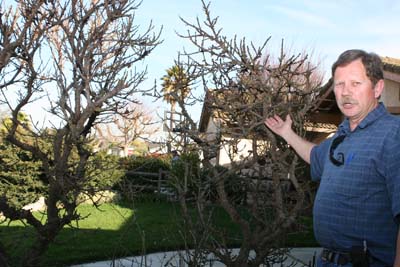
Behind a simple desk tucked in the corner of an office in the Veterans Memorial Building in downtown Hollister sits a human repository of local agricultural knowledge. With Bill Coates’ retirement this week after nearly 35 years in the UC Cooperative Extension office, that knowledge won’t be as easy for growers to access anymore.
It is a situation being repeated around the state, where the number of county-based farm advisors has dropped from 400 during the 1980s to approximately 180 today.
“A majority of people working in tree, fruit and nut crops across California are retiring soon,” said the 61-year-old Coates, an expert farm advisor who has been relied upon by growers in San Benito, Santa Cruz, Monterey and Santa Clara counties for everything from scheduling optimal watering cycles to determining the best way to get rid of pests that can damage a crop.
Coates was the expert that farmers from around the Central Coast would call with questions about the walnut husk fly or black line disease in walnuts. His research has ranged from methods to reduce the amount of pesticides to ways to control pests that can devastate crops.
His retirement, prompted both by a desire to spend more time with his family and because of University of California budget issues, “is just about going to eliminate tree crop experts around the Central Coast,” Coates said. “There’s a lot of research and extension of knowledge that comes from the UC extension office. The agriculture commissioner’s office, farmers and magazines will help fill some of that void, but a lot of the applied research that goes into that information originates with us. It’s slowly disappearing.”
Coates said he plans to stay busy, with hopes of updating a publication on home fruit gardening in San Benito County and writing a report on the county’s climate.
“I have one child already graduated from college and two who have completed their freshman year,” he said. “I want to do some traveling and gardening. I haven’t had time to keep up with everything I’d like to do. I want to refurbish my garden.”
When he started in September 1976, his office included a mimeograph machine. Today, farmers e-mail him photos of their crops “so I don’t have to drive an hour to diagnose a problem.”
See the full story in the Pinnacle.