

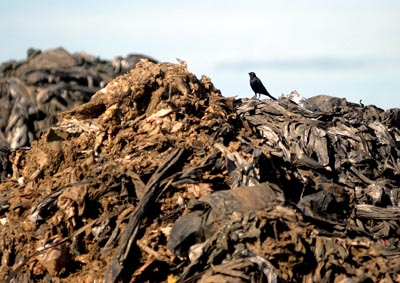
The county’s John Smith Landfill has a 1,000-ton pile of
agricultural-related plastic waste no one wants.
”
So what?
”
you may be thinking.
”
That’s what landfills are for.
”
True, but we subsidized this pile by reducing the disposal cost
because we thought we had buyers who would pay to recycle it. That
would have been a good deal had it gone through, but it flopped.
The market disappeared
– but the plastic did not – and now we have to find the best way
to get rid of it.
The county’s John Smith Landfill has a 1,000-ton pile of agricultural-related plastic waste no one wants. “So what?” you may be thinking. “That’s what landfills are for.” True, but we subsidized this pile by reducing the disposal cost because we thought we had buyers who would pay to recycle it. That would have been a good deal had it gone through, but it flopped. The market disappeared – but the plastic did not – and now we have to find the best way to get rid of it.
At this stage, it will either cost us money or landfill space – which is the equivalent of money – no matter what we do. It’s not a good deal any longer. That may change again tomorrow; this is a business arena fraught with uncertainty.
This episode should teach us an old, but important, lesson if we are willing to recognize it. Just because a project sports a green label does not mean that it is economically or environmentally sound. Unfortunately, care and skepticism are not in vogue, especially when the bandwagon rolls by. We give every new concept a snappy title, lots of hype, massive government incentives and then we ignore the failures or cook the books. As the ideas prove unworkable, the costs are too often buried just like the 1,000 tons of subsidized waste.
Our national motto is no longer, “In God We Trust.” Now it’s, “On to the next challenge – blindly.”
What we tend to forget is that all the tried and true business rules still apply even if the technology is new – the benefits of any system are usually oversold and the shortcomings understated because people have vested interests. The less you know, the more danger there is. These stakes may be financial, political, philosophical or ego driven, but more than a few level-headed people have put their normal skepticism aside and joined the parade because everyone else was marching or because they approve of the destination.
The best measure of how anything is going to do in the future is how it has done in the past; this applies across the board. However, this does not mean that we should never take a chance on new ideas, opportunities or talent. What it means is that a prudent approach is not to bet everything on a single roll of the dice. It’s best to let someone else make the big mistakes that usually come early in any new venture. There is no test as discriminating as the test of time.
As the title of a popular TV show advises, we need to curb our enthusiasm. When systems mature their true value, actual potential and hidden problems become much clearer than they were going in.
A recent article pointed out that Massachusetts and Rhode Island are racing to build the nation’s first offshore wind farm and that a primary factor in this race is the “rivalry to be the first state to have an offshore wind project in the nation.” Excuse the wordplay, but they are throwing caution to the wind farm all for the honor of being first. Learning from the mistakes of others – maximizing your upside gain while minimizing your downside risk – appears to be out of style in a world where hyperbole rules.
For too many it’s more important be the first and the biggest. I’d argue that it’s always more important to be the best.
The call to go green should not be an excuse to check one’s good business sense at the door.
Marty Richman is a Hollister resident.