
Learning how and what to recycle is good for everyonehow and
what to recycle is good for everyone
When is a plastic bottle not a plastic bottle?
When it’s a shirt.
Recycling has come a long way from the days of collecting tossed
aluminum cans from the side of the road. Today, almost everything
humans use can be recycled in some way, helping to reduce the
amount of trash put into dumps each year and creating a healthier
planet for future generations. Plastics, for example, can be turned
into clothing such as t-shirts and jackets, landscaping materials,
carpet, binders and even lumber.
Learning Learning how and what to recycle is good for everyonehow and what to recycle is good for everyone
When is a plastic bottle not a plastic bottle?
When it’s a shirt.
Recycling has come a long way from the days of collecting tossed aluminum cans from the side of the road. Today, almost everything humans use can be recycled in some way, helping to reduce the amount of trash put into dumps each year and creating a healthier planet for future generations. Plastics, for example, can be turned into clothing such as t-shirts and jackets, landscaping materials, carpet, binders and even lumber.
“Earth’s resources are finite,” said Mandy Rose, director of San Benito County’s Integrated Waste Management department. “Recycling helps us all to continue living on this planet.”
The Integrated Waste Management Act, passed in 1989, requires every city and county in California to divert from landfills at least 50 percent of the waste generated within their jurisdiction by 2000. San Benito, as well as Hollister and San Juan Bautista, have not yet met that goal, although as of 2006, the county had reached a 47 percent diversion rate, Rose said. Counties and cities could be fined as much as $10,000 a day if a “good faith effort” toward waste diversion is not regularly met.
The curbside recycling program adopted by Hollister in 2002, as well as the recycling efforts in the unincorporated areas of the county, are a major reason why SBC is inching closer to that 50 percent goal. All homes in the county receiving garbage service must also participate in the recycling program.
What needs to happen now, Rose said, is educating residents in how to recycle. That should happen soon, as Norcal Waste Systems prepares to take over the city’s garbage and recycling contract beginning July 1, replacing long-time contractor Waste Management, Inc. (Hollister Disposal). Norcal already handles trash/recycling pick-up in the unincorporated county area.
“When the bins were first delivered, there was a printed handout with them detailing how and what to recycle,” Rose said. “Now, with the upcoming transition, we will be revisiting the how-to’s. The information is out there. People just need to be reminded of it.”
Although some communities require residents to separate recyclables by materials (plastics, glass, metal and paper), San Benito residents are asked to put all recyclables into a large, blue 64-gallon recycling cart. Recycling picked up by Norcal is taken to a transfer station in San Martin, where it is reloaded onto semis for delivery to a Materials Recovery Facility (MRF) in Castroville. Sorters at the MRF separate the materials into their proper categories, said Phil Couchee, Norcal general manager.
After materials are separated, they are prepared for shipping worldwide to be turned into recycled items. Paper can become a box or insulation; glass can turn into road surfacing; plastics can become clothing, piping and even lumber.
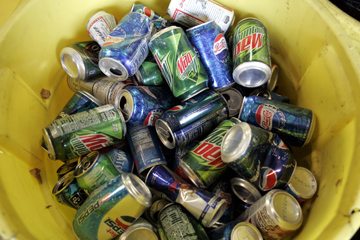
“Take a look at a Coke can,” Couchee said. “In three months, it can be made into a Coke can again.”
“Or an aluminum bat,” Rose added.
It is important that items are separated correctly, Couchee said, not only because of what they will be used for but because different items are worth different amounts. Most paper is recyclable, for example, but not all paper will bring in the same amount of money. The value of recyclables is constantly changing, Rose said.
“Much like the stock market, prices go up and down,” she said. “Materials often command a different price around the world. And people know what is valuable. If the value of cardboard is high, you might see people pulling it out of bins.”
One of the first steps to a successful recycling program is teaching people what not to throw away, Rose said.
“I have residents ask me ‘what should I put in my recycling bin’ and I always say ‘if you don’t mind, can I ask you what you throw away?'” she said. “Not everyone gets it. If you go into our landfill, or any landfill for that matter, you will see so many valuable resources are being thrown away every day.”
A common misconception is that items tossed into the garbage will be sorted before being taken to the landfill, Rose said.
“Some people believe if it’s recyclable, that item will be taken out of the garbage,” she said. “That’s not true. If someone accidentally throws something away, it stays there. No one is going to take it out.”
Rose said there is often a “disconnect” between recycling for the sake of the planet and recycling for money.
“When we first started a recycling program, people thought that they weren’t going to give us their recycling because they wanted their money back,” she said. “And if they want to take it in, that’s great. But there are a lot of recyclables, such as yogurt containers, shampoo bottles or mayonnaise jars, that aren’t worth money but should be recycled.”
The average Californian creates about six pounds of waste each day; most of it is recyclable, according to the California Integrated Waste Management Board. But what isn’t, and often stuff that is, finds its way into a landfill.
John Smith Landfill in San Benito County is presently permitted to accepted 250 tons of waste daily, far less than the 1,000 tons accepted at some of the state’s larger landfills, Rose said. However, estimates put the life of John Smith at 22 more years, and although the county owns 133 acres adjacent to the landfill, expansion plans are far from finalized.
“Recycling is critical,” Couchee said. “It’s not just about maintaining resources, but about how many landfills can we really have on this planet?”
Rose points to recent struggles Santa Cruz County supervisors had when attempting to establish a new landfill. After a five-year search, several suitable sites were rejected when residents living near them objected to having a landfill next to their homes.
“Finally, the supervisors said ‘Great. We hear you. You don’t want a landfill. So you’d better start making less waste,'” Rose said. “And now residents who don’t meet set waste guidelines can be fined.”
Hollister residents will soon be receiving new recycling bins, along with instructions on how to properly recycle, Couchee said.
Little things add up to a big difference
Mankind is a bit like an invited houseguest who overstays his welcome.
It treats the earth with a sense of disregard, absentmindedly going about its business with little or no thought to the repercussions of its actions.
Scientists are now calling these actions “footprints,” and human beings are leaving them everywhere. Today, there are two types of footprints that are raising concerns among environmentalists, ecologists and scientists – carbon and ecological.
A carbon footprint is the measure of the impact human activities have on the environment in terms of the amount of greenhouse gases produced, according to the California Department of Conservation. The gases are measured in units of carbon dioxide. These measurements are intended to help individuals and organizations to visualize their personal contributions to global warming.
An ecological footprint is the measure of human demand on the earth’s ecosystems and natural resources. It compares man’s use of natural resources with the earth’s ecological capacity to renew them.
With the public debate over global warming intensifying, policymakers both in the United States and worldwide are looking at ways to reduce carbon dioxide and other green house gases.
In the meantime, there are a few ways individuals can reduce their personal carbon footprints. These tips, provided by the California Department of Conservation, include:
1. Recycling – Recycling beverage containers is one of the easiest things people can do to reduce their carbon footprint. Consider this: it takes 20 times more energy to make aluminum can from new materials then from recycled aluminum.
2. Buy recycled – Purchase goods made from or packaged in recycled materials. Products made from recycled materials often require less energy than using new resources. There are several Web sites offering products made from recycled items, such as www.greengiftguide.com or www.ciwmb.ca.gov/RecycleStore/.
3. Start a recycling program at work – Order a free recycling starter kit for your business, school or organization from the Department of Conservation at www.cansandbottles.com. The kit comes with posters, easy-to-follow instructions and a beverage container recycling bin.
4. Tune-up the car – Regular maintenance helps improve fuel efficiency and reduces green house gas emissions.
5. Leave the car at home – Find alternative transportation at least one day a week. Try walking (if possible), carpooling, public transportation or bicycling. Eliminating just one mile of driving can reduce a whole pound of greenhouse gas emissions.
6. Conserve energy at home – Cut monthly energy bills by 30 percent by switching to Energy Star appliances. Turn off lights when not in a room. Keep the thermostat at 70 degrees or lower in cold weather and 78 or higher in warm weather. The average household can save 3 percent on heating costs for every degree reduced on a thermostat setting.
7. Conserve at work – Enable your computer’s energy saving features when in use. Turn off computer equipment at night and any other time it doesn’t need to be on. Switch to LCD monitors if possible; they consume only 20-50 percent of the energy of conventional monitors. Be conservative about printing needs to reduce the amount of paper used at the office.
8. Unplug it – Unplug items such as cell phone chargers, hair dryers, televisions, lamps and other household electronics from the wall when not in use. Even if they are turned off, they still draw small amounts of electricity if left plugged in.
9. Plant a tree – A single tree will absorb one ton of carbon dioxide over its lifetime. Shade trees can also reduce air conditioning costs by 10-15 percent.
10. Recycle bottles and cans everywhere you go – Use curbside bins and check areas for recycling cans before dropping plastic bottles, cans or glass beverage containers into the trash.
Source: The California Department of Conservation. For more information, visit the department’s Web site at www.cansandbottles.com.
Talking trash
Here’s how to figure out which items are considered curbside recycling and which ones should be taken to a recycling center or tossed in the trash.
Glass: Do recycle – unbroken food and beverage containers, such as pasta sauce jars, condiment jars, beer and wine bottles. Be sure to rinse containers clean of most remaining foods, although a few drops of soft drink won’t hurt anything. Don’t recycle – baking dishes, ceramics, mirrors, windows or knick-knacks such as vases or figurines. These items are made differently than containers and can contaminate recyclable materials. Glass becomes new food containers, landscaping materials such as pebbles, home tiles and road surfacing.
Paper: Do recycle – newspapers, magazines, catalogs, cardboard and mixed papers such as cereal boxes or telephone books. Milk cartons – once non-recyclable – are now fine to return for reuse after a quick rinse. Don’t recycle – wet paper products, food-stained papers, tissues, stickers or those containing metal foil, plastic or wax coatings. Paper becomes newsprint, boxes, insulation and animal bedding.
Plastic: Do recycle – plastics with a number 1 or 2 inside the recycling triangle located on the container. These include most beverage bottles, milk jugs, peanut butter jars, dish soap and laundry soap/fabric softener bottles. Don’t recycle – plastics numbered 3-7 until acceptance at a local recycling facility is verified. These include squeezable bottles, shrink wrap, Styrofoam trays or polystyrene containers. Plastics 1 and 2 become beverage and shampoo bottles, pipes, fencing, lumber planks, jackets, lining and fleece. Other plastics bond too easily to other materials and can contaminate them.
Metal: Do recycle – aluminum and steel, disposable aluminum pans and empty paint and aerosol cans. Don’t recycle – any other metals curbside. Call a local recycling facility before putting questionable metals into the bin. Aluminum becomes beverage cans, bats and other sporting equipment; steel can become new appliances or auto parts.
Buy a soda, earn some cash
There’s more to your favorite beverage than just great taste. Many cans and bottles are worth money, as well.
Thanks to the California Refund Value (CRV), consumers can recycle their glass, plastic and aluminum containers for cash. The current CRV rate is 5 cents for containers less than 24 ounces and 10 cents for containers 24 ounces and larger.
Most recycling centers pay by the pound, although consumers can request to be paid on a per-container basis if their loads contain fewer than 50 per material type. In those cases, the recycler will pay by count instead of by weight.
The following containers have a CRV: carbonated soft drinks; wine coolers; distilled spirit coolers; beer; carbonated and mineral water; non-carbonated water; sports drinks; coffee and tea drinks; fruit drinks; fruit juices packed in containers less than 46 oz.; vegetable juice in containers 16 oz. or less.
Beverages that don’t have a CRV include: milk; medical food; nutritional supplements; infant formula; wine; 100 percent fruit juice in containers 46 oz. or more; vegetable juice in containers larger than 16 oz.
For more information, call the California Department of Conservation at 1-800-RECYCLE or go to www.cansandbottles.com.