

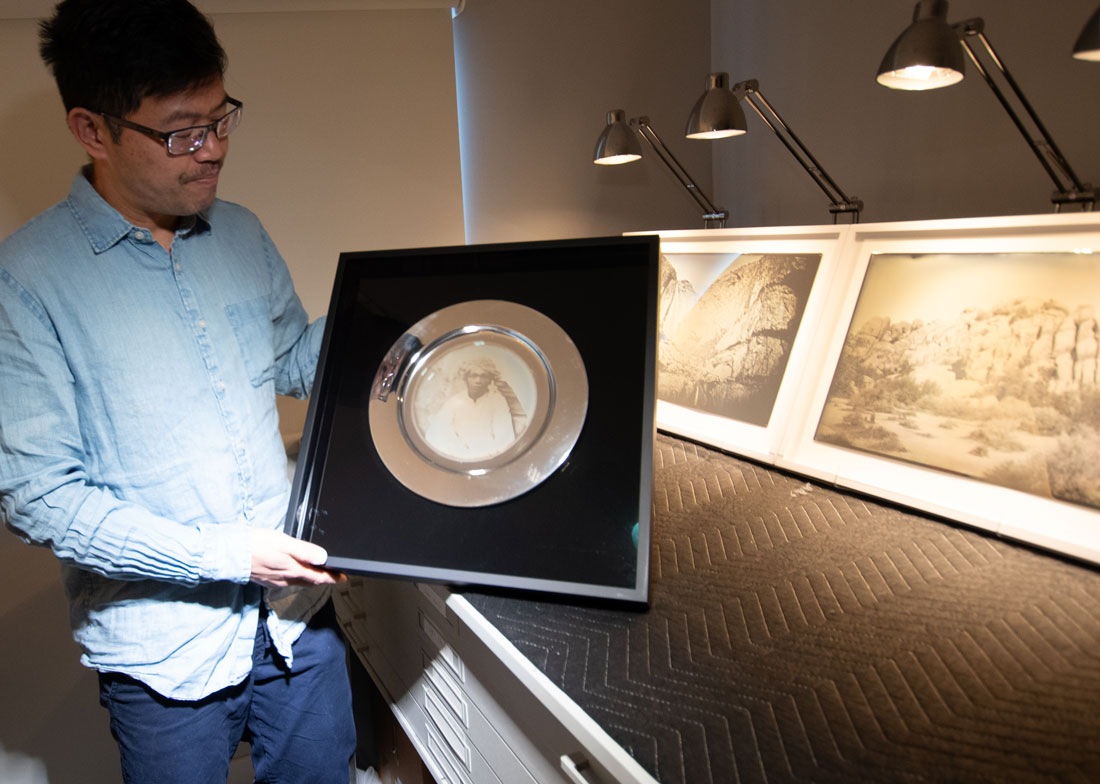
When Binh Danh looks into the reflective surface of his daguerreotypes featuring America’s national parks, he sees more than sweeping vistas of Yosemite Valley or the Yellowstone Falls. He sees himself.
The mirror-like surface of each photograph reflects the viewer back into the landscape, creating a layered image the Gilroy-based artist says evokes fundamental questions about belonging, access and identity in public spaces.
“I love how it layers your body or your face on top of these national parks and these national landmarks,” said Danh, a San Jose State University art professor. “Hopefully, whoever you are or wherever you are, you will have this relationship to this place.”
The Center for Photographic Art in Carmel-by-the-Sea will present “Belonging in the National Parks,” a solo exhibition of Danh’s work, from Feb. 14-March 22. The exhibition is free and open to the public. Danh will give an artist talk from 3-4pm Feb. 14 at the Sunset Center, followed by an opening reception from 4-6pm.
The exhibition features more than 50 daguerreotypes representing 15 years of work across multiple national parks and historical sites.
The historical photography technique of daguerreotype was the first photographic process invented. Introduced in France in 1839 by Louis Daguerre, the process involves coating a copper plate with silver, polishing it to a mirror finish, then sensitizing it with iodine vapor before exposing it in a large-format camera.
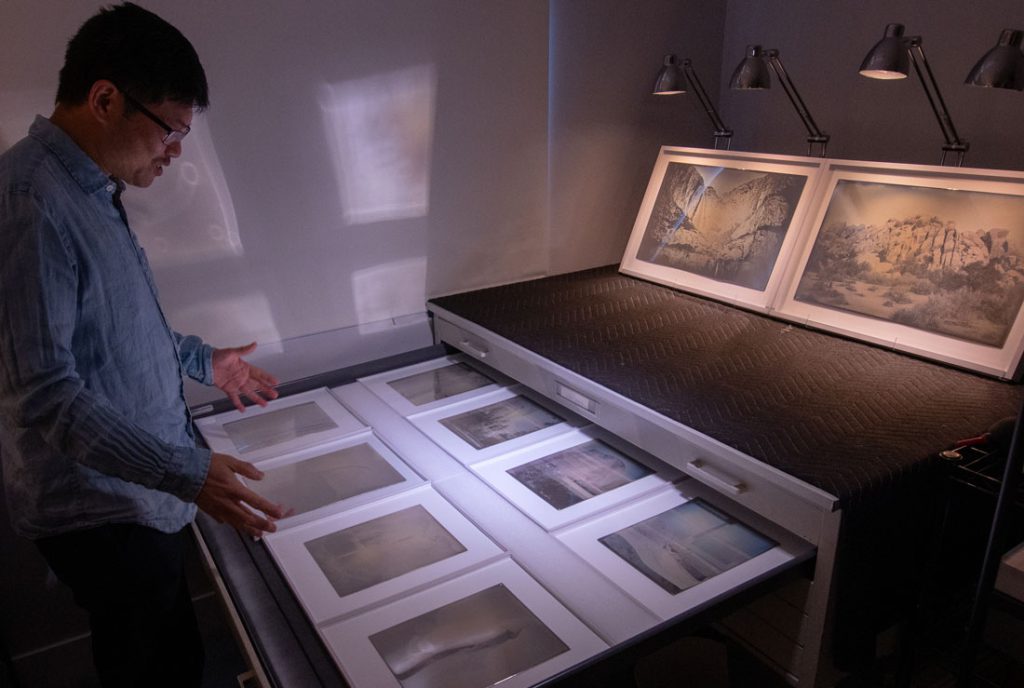
Each photograph is one-of-a-kind. There are no negatives, no digital files. The plate that goes into the camera is the final art piece, and when you can only carry a handful of the cumbersome metal plates to remote locations, the margins for error are slim.
The process is painstaking and hazardous. Danh converts a van into a mobile darkroom, complete with a fume hood, and develops plates over warm mercury vapor. He hikes up to four miles carrying 45 pounds of equipment: a 25-pound camera, 15–20 plates, and a heavy tripod necessary to keep everything stable during the minutes-long exposures.
This bespoke equipment is not available on the open market—Danh manufactures everything himself, reverse-engineering the process after reading original documents from the first generation of photographers.
“How I sort of figured this out was, I actually read these 19th-century handbooks that I found online,” he said. “I just read it all, and I tried it out, and I kept trying. I sort of tweaked it until I was able to figure it out. It took me like 10 years.”
Everything is hand-crafted in Danh’s backyard workshop, where he polishes the copper plates to a mirror finish and electroplates them with silver.
“And the cool thing about the daguerreotype is, their image is really sharp because there’s no grain,” Danh said. “It’s all nanotechnology. The light shines on it and the image gets recorded in the silver crystal, so there are no pixels, or what we would call ‘grain’ today.”
Danh, 49, grew up in San Jose, the son of Vietnamese immigrants who ran a television repair shop. He discovered photography in fifth grade during a science camp trip, when he begged his father for a point-and-shoot camera to document the experience.
“I thought it was the most American thing to do,” he recalled of the camping trip. “We never really had time to go out.”
After earning his bachelor’s degree from San Jose State University in 2002 and a master’s degree in 2004, Danh taught throughout the Bay Area before accepting a tenure-track position at Arizona State University. He returned to San Jose State as a teacher in 2019 and moved to Gilroy, where he maintains his studio.
Danh began photographing the national parks in 2012, initially drawn to Yosemite Valley. For years, he had avoided photographing the iconic landscape, believing he had nothing new to say about a place so thoroughly documented by photographers like Ansel Adams and Edward Weston.
The daguerreotype process changed his perspective. The reversed, mirror-like images transform familiar landscapes into something simultaneously old and new.
“When you reverse an image, it looks different even though it looks familiar,” Danh said. “It’s almost like the way when people see pictures of themselves and they realize, oh, do I really look like that?”
The work takes on added urgency in the current political climate. Danh notes that recent changes to national park policies—from new hiring processes including employee loyalty questions to the removal of historical signage about slavery and internment—have made public lands a contested political space.
“The national park is this open space of democracy, and democracy is also at play right now,” he said. “When we planned this show, this was years ago… we had no idea that things were going to be this crazy at this moment.”
Some of the images in the exhibition document views that no longer exist or are inaccessible to the public. One daguerreotype shows Lower Yellowstone Falls from a staircase that has been closed for at least five years due to disrepair and lack of funding.
Another captures the Trinity Site in New Mexico, where the first atomic bomb was tested, which the military no longer opens regularly to visitors.
Danh drew inspiration from contemporary criticisms of Adams and Weston, who photographed “rocks and trees” during an era when war and social upheaval raged, and many discounted the value of landscape photography—but Danh sees his work as part of the same conservation legacy.
“Their work helped save national parks,” he said. “I’m part of that legacy too. I also believe in our human relationship to these spaces.”
The exhibition asks viewers to consider who has been welcomed into national parks and who has been excluded, questions particularly resonant for the son of immigrants who found a sense of belonging in photographing the parks.
“We’re a nation of immigrants, and when we go to the national parks, we feel more rooted to this land,” Danh said. “I think that is so amazing.”
For additional information about “Belonging in the National Parks,” visit photography.org/events/binh-danh-belonging-in-the-national-parks.