

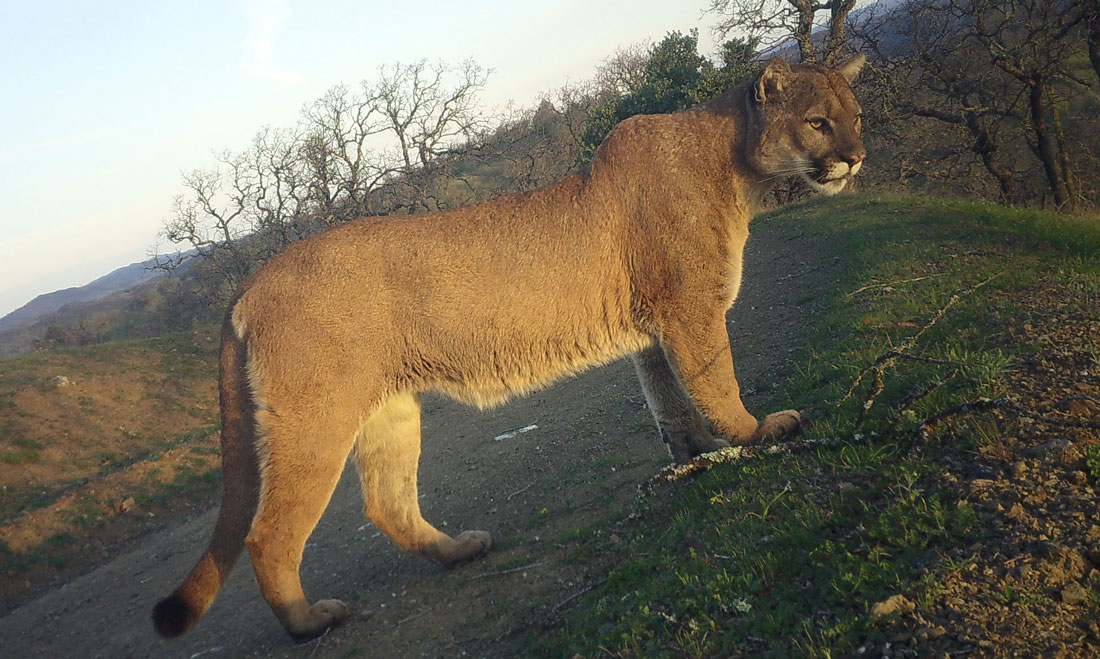
A series of letters published in South Valley newspapers over the past several months claiming that mountain lions are dangerously overpopulated in the Santa Cruz Mountains has drawn sharp disagreement from researchers and wildlife managers who say the claims misrepresent how the species’ populations work.
Phil Salgado, a Morgan Hill resident who lives in the western foothills along the Santa Cruz Mountains, has published at least four letters in the Times since December arguing that the local mountain lion population is under what he describes as “intense territorial pressure.”
“All my information and numbers come from official sources like the Department of Agriculture or the Department of Fish and Wildlife,” Salgado said. “The Department of Fish and Wildlife states that mountain lion home ranges are between 100-500 square miles. I take the minimum of 100 square miles and the state’s estimated 4,500 mountain lions, and that gives them a need for 450,000 square miles. California is only 164,000 square miles.”
Scientists who study the population say that assumptions behind that math are fundamentally flawed.
“He makes a lot of references and draws conclusions that show no understanding of how animal populations actually work,” said Rick Hopkins, a wildlife researcher who studied mountain lions in the Diablo Range for nearly a decade. “He’s assuming something that’s false, that home ranges don’t overlap.”
Hopkins explained that mountain lions cannot physically defend a home range of 60-80 square miles, the typical size for a male. In his Diablo Range study area, he documented as many as 10 adult lions per 100 square miles in its areas most isolated from humans.
Chris Wilmers, a professor in the Environmental Studies Department at UC Santa Cruz and director of the Santa Cruz Pumas Project, which has tracked the local lion population for years using GPS collars and camera traps, said densities in the Santa Cruz Mountains run on the low end of two to three animals per 100 square kilometers, or roughly five to six lions per 100 square miles.
That density figure is several times higher than Salgado’s estimate of one lion per 100 square miles, and well below the crisis level he describes.
Salgado also argues in his letters that mountain lion sightings are at an all-time high because lions are losing their fear of humans. On this too, researchers disagree.
“That argument has been floating around for 50 years and keeps coming up with no real evidence,” Hopkins said.
He noted that research consistently shows mountain lions actively avoid human-dominated landscapes, using them less frequently than their availability within a home range would predict. Young males leaving their mothers’ territories are the most likely to appear in residential areas, he said, not because they have lost their fear of humans, but as a part of a natural dispersal behavior that allows for gene flow across regions.
“When young lions are old enough to leave their mothers, they disperse into adjacent territories,” said Aaron Hebert, natural resources manager for the Santa Clara Valley Open Space Authority. “That’s why we think we see lions in more urban areas: they’re looking for habitat.”
Researchers attributed the apparent rise in sightings largely to the proliferation of smartphones, Ring cameras and trail cameras over the past decade, and the ease with which video can now be shared on social media.
“Sightings are not a metric of changes in population,” Hopkins said. “They’re more a metric of how many people now have Ring cameras or trail cameras.”
Despite the disagreement over population numbers, Salgado said his primary motivation is not to vilify mountain lions but to raise awareness about what he sees as an unworkable state policy.
“I don’t hate mountain lions,” Salgado said. “It’s that there’s too huge of a gap between how the law treats victims of mountain lion attacks compared to attacks by other animals, and it needs to be balanced out and updated.”
Under California’s current three-strike depredation policy, property owners must document multiple livestock or pet losses before becoming eligible to request a depredation permit allowing a problem lion to be killed.
Salgado argues the policy is unenforceable in practice when a mountain lion can kill an entire small herd in a single night, eliminating the possibility of a second or third strike.
“Some people, like myself, only have two animals—not enough for a second or third strike,” Salgado said, noting that his efforts to spread awareness about mountain lion policy began with concerns for his own pets’ safety.
“I have two cats, Trixy and Shadow, that I rescued from birth,” he said. “I bottle-fed them, paid all their vet bills, and they’re very important to me.”
Hopkins noted that the majority of depredation reports stem from attacks on livestock, with only 11% of attacks reported on dogs and cats. The majority of attacks target larger animals like goats and sheep, more similar to the deer and elk that mountain lions would typically hunt in the wild.
“They disproportionately occur where there are large ungulates,” Hopkins said. “They don’t occur where there aren’t large ungulates to speak of, because they can’t get enough food otherwise.”
Hebert acknowledged the tension between livestock protection and lion conservation is real, and said the Open Space Authority tries to address it in part by charging grazing tenants well below market rent to help offset losses that come with operating in lion habitat.
“We need grazers to help manage our grasslands,” Hebert said. “These are obviously also home to mountain lions and other predators, so we try to make sure the rent they pay accounts for what is a really tricky management issue.”
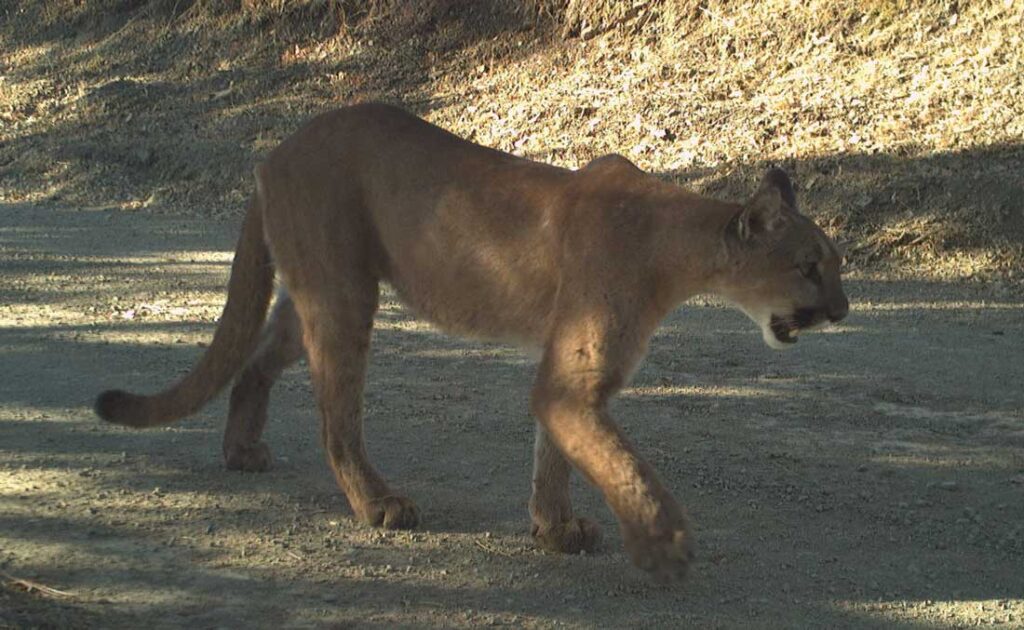
Lack of diversity a concern
The broader scientific concern about the Santa Cruz Mountains population, researchers say, is not over- or under-population, but genetic isolation: the population is cut off from neighboring territories and becoming inbred to a degree that threatens its long-term survival.
In February, the California Fish and Game Commission voted unanimously to list mountain lion populations in parts of southern California and the central coast, including those in the Santa Cruz Mountains, as a threatened species under the California Endangered Species Act (CESA).
Hebert said the Santa Cruz Mountains population is surrounded on nearly all sides by development, the Pacific Ocean and major transportation corridors, leaving lions with no natural outlet for the dispersal behavior that maintains genetic diversity in healthy populations. One visible sign of inbreeding stress, he noted, is the kinked tail now commonly documented in local lions.
“They can’t just keep inbreeding over time and survive,” Hebert said.
Wildlife corridor projects in Coyote Valley, where the Open Space Authority and partner organizations are working to restore a habitat connection between the Santa Cruz Mountains and the Diablo Range, are intended to enable lions to exchange genetics across what has become an island of habitat.
Without that connectivity, Hebert said, the population faces a long-term decline regardless of its current numbers.
Salgado said he plans to continue publishing letters and raising awareness about current mountain lion policy and how to properly report attacks on pets and livestock.
“A lot of ranchers don’t really know what the policies are,” he said. “They were being given the runaround on reporting. I just wanted to get that information out there for local public safety.”
Researchers stressed that while it may seem like lions are being pushed into residential neighborhoods, in truth, developments increasingly encroach on mountain lion habitat.
“When we’re thinking about housing, clean energy and all the things our state needs, let’s not forget about wildlife and the way wildlife moves through the landscape,” Hebert said. “There are ways to make sure wildlife connectivity is part of how we advance all those other important issues.”








This article states that the “truth” is that we are encroaching on mountain lion habitat. In our santa cruz mountains the opposite of encroaching is happening. The Big Basin Facility Management Plan 2026 is returning massive connected pieces of land back to nature. This includes major campgrounds Blooms Creek, Sempervirens and Wastahi be decommissioned. Non profits make millions of dollars in grants and donations under the belief that mountain lions are endangered facing extinction. To admit mountain lions have reached carrying capacity would contradict their need for funding.