

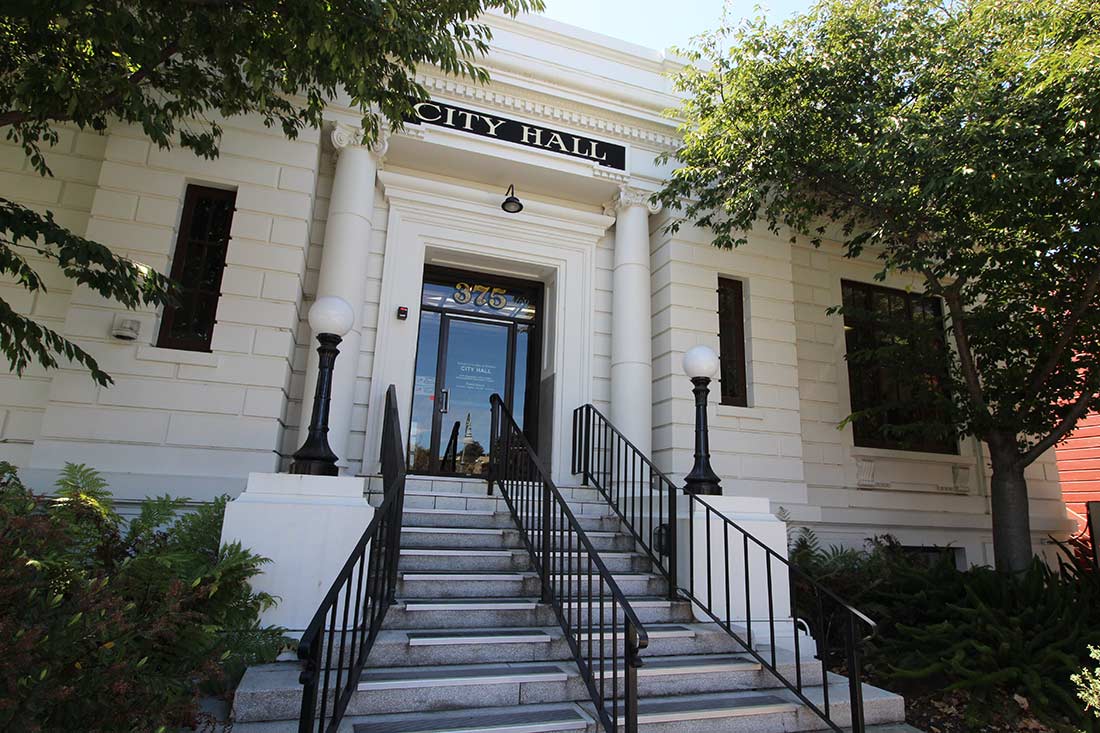
Facing such a bleak financial position that City Hall didn’t have enough cash to pay its employees as of last week, the Hollister City Council on Oct. 2 declared a local “state of financial emergency” and approved a loan of $18 million from its impact fee funds to cover wages and other general fund expenses.
At the special Friday night meeting, Hollister City Manager Ana Cortez explained that the city’s financial situation has steadily deteriorated over at least the past decade—largely due to official mismanagement and lack of oversight—to the point that the council can no longer ignore the problem.
At the end of September, Cortez said, the city’s general fund bank account only had $178 available. The city does not have any cash in a reserve fund that was flush with nearly $7.8 million as of June 2025.
“We cannot make payroll next week,” Cortez told the council on Oct. 2. “As of now, we have no way of meeting our payroll because we do not have funds in the general fund to pay people.”
The city’s next payroll is due Oct. 6. The council on Oct. 2 unanimously approved a staff-recommended $18 million loan from the city’s impact fee funds. Of that amount, $11 million is loaned to the general fund and $7 million to the water fund.
The city must pay back the loan by June 30, 2027, with 4% interest, according to city staff.
But the city must continue to seek more long-term solutions to its financial problems, which include an ongoing deficit of $2 million in the general fund and $3.4 million in the water fund, according to city staff. Eleven funds within the City Hall budget currently have a “cash-negative balance.”
On top of that, city staff estimate Hollister has about $200 million worth of repairs to make to its water system, but has not raised water or sewer rates since 2018.
Also at the Oct. 2 meeting, the council unanimously approved a resolution authorizing city staff to ask Hollister’s state representatives to consider legislation that would allow the city to increase its total sales tax cap by one percent. The city’s current sales tax rate is maxed out at a rate of 9.25% allowed by state authorities—keeping the city from asking voters to tax themselves at a higher rate.
If the state approves a 1% increase in Hollister’s sales tax cap, that would pave the way for the city council to explore a sales tax ballot measure as a means to raise ongoing revenue, city officials explained.
The council also approved a formal declaration of financial emergency—a statement that shows city officials are aware of the problem and know they have to address it, Cortez explained. The declaration is a signal to creditors, grant providers and the public that the city is serious about fixing its finances.
“The proclamation says, as a city we understand the situation we are in, and we understand where it came from. To our creditors, it says, we will pay you,” Cortez said.
The city’s financial situation is not a surprise to the city council, city staff or many members of the public—some of whom spoke at the council meeting pleading for more transparency and urging officials to avoid City Hall layoffs.
The city’s position is a result of several years of mismanagement and lack of oversight by previous city officials, according to city staff.
“We have not reconciled our bank account for four years,” she said. “We have not balanced our checkbook.”
Cortez—who joined City Hall as city manager in February—presented a laundry list of bad practices and failures over the years, including:
• The illegal transfer of special or restricted funds to pay for general fund expenses.
• Inadequate internal financial controls.
• Insufficient segregation of financial duties and responsibilities.
• The lack of adequate general fund reserves.
• Incomplete or untimely financial reporting to the city council.
• Weaknesses in cash and asset management, contract and lease administration, revenue collection and banking controls.
• Use of one-time funds to increase the city’s expenses.
• The absence of city budget audits since 2022.
“And the list goes on,” Cortez said.
In recent months, under new City Hall leadership that includes Cortez and Finance Director Jessica O’Connell who joined Hollister in March, Cortez said staff have begun to change these practices and reconcile past years’ bank statements.
That includes conducting audits of each of the last five years’ city budgets; implementing better cash management procedures; strengthening banking controls; reviewing leases and outstanding obligations; reviewing city assets and liabilities; and other measures.
In the coming months, Cortez added, the council will have to make more difficult decisions, including raising water rates and declaring some city property as surplus for potential liquidation.
During public comment, some city staff members urged councilmembers to hold off on declaring a financial emergency, and criticized city officials for a perceived lack of transparency on Hollister’s finances.
“It’s a complete lack of leadership that we’re seeing,” said Bo Leland, a Hollister Police officer speaking for the local Police Officers Association. “We’re not being consulted. It’s frustrating. People who are new to the city are coming in making decisions about people’s lives. Critical times call for critical leadership. We’re not experiencing any leadership at the employee level.”
Councilmember Rudy Picha asked city staff to clarify that City Hall is “not hiding anything” about its budget or finances, and noted that city websites include options to sign up for alerts for meeting agendas and other timely documents.
“We haven’t really been running your town very well and you have every right to be angry,” said Picha, who was elected to the council in 2024. “We really need to run the town better.”








Dear Friends, For more than 35 years I’ve said to local elected officials that we ought to stop wasting taxpayers’ dollars, motorists gas tax dollars & sales tax dollars on wasteful public sector transit. If we wasted less, then maybe we’d have more money for essentials. Instead of heeding my advice, probono as it always was, unelected Directors at the transit agency SBCCOG deem it essential to run nearly 100% empty buses around SBC, as do other waste-loving Counties like VTA in SCC, TAMC in MC, etc., one in each County. Why? The powerful vested interests who control decision-making at SBCCOG and the other transit agencies demand that taxpayers subsidies increase even though fewer patrons ride (as in get a free ride courtesy of taxpayers). SBCCOG violates our law (farebox recovery statute Pub.Util.C. 99268.2) by omitting costs in their financials, which our Legislature authorizes in Pub.Util.C. 99268.17. If private sector passenger carriers so falsified their financial results they’d be prosecuted for false advertizing, fraud, and violation of the Unfair Business Practices Act. Let’s try ending fraud, waste and abuse at the transit agencies, and let’s have truth-in-transportation. Let’s have fewer governance abuse caused financial emergencies for a change. Caveat viator. Joe Thompson
[Trackback]
Info to that Topic: sanbenito.com/hollister-city-council-declares-financial-emergency/