
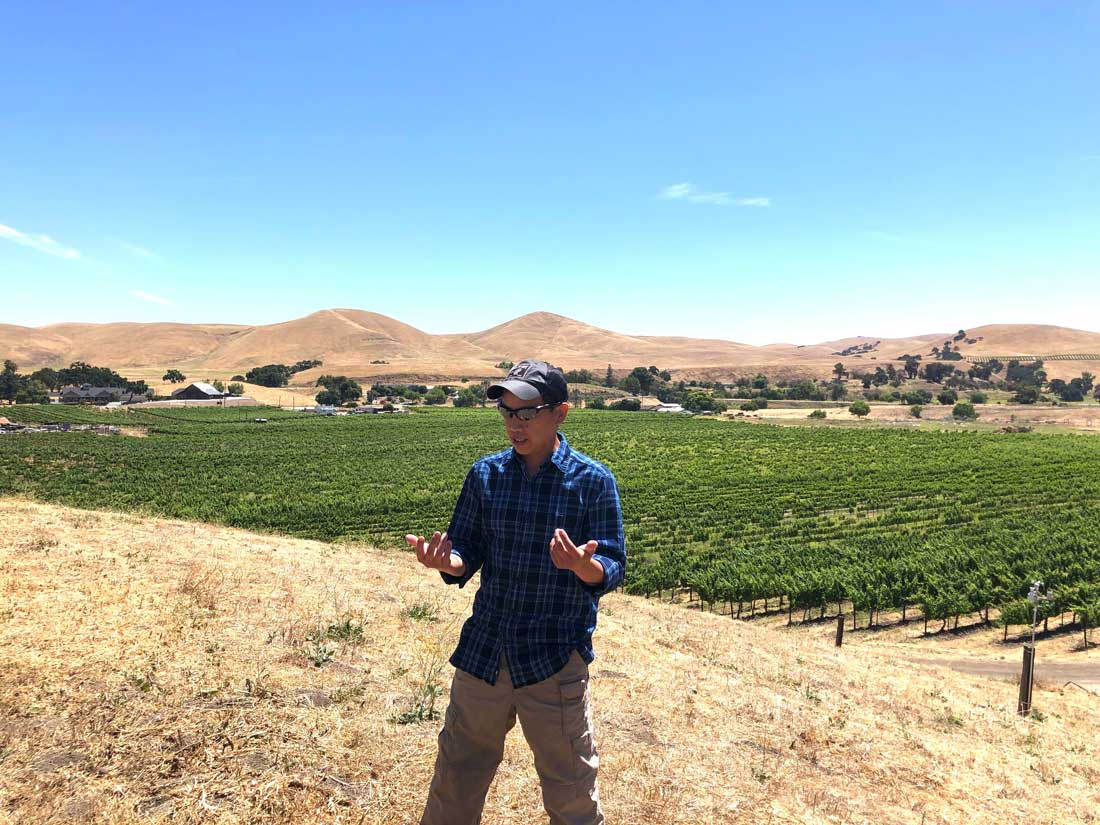
Winemaker, winegrower and ornithologist, Nat Wong, has made San Benito County home since shortly after experiencing the allure of wine on a trip to France. While drinking Cabernet Franc in a vineyard in Bourgeil, something stirred his soul.
Fascinated by wine, he began apprenticing in 2019 at Folktale Winery in Carmel Valley, where he worked with winemaker David Baird. Wanting to make his own wine, he was introduced to San Benito County powerhouse grapegrower, Ron Siletto, who is famous for planting three large vineyard parcels with a true candy store of offbeat varietals.
While they seemed avant garde at the time, this former president of Almaden Vineyards, once one of America’s largest wine companies, knew what he was doing when he planted three distinct parcels.
Wheeler was the first to be installed in 1974, followed by Calleri Vineyard, which was planted in 1994 and Siletto Vineyard in 1995. Varieties like Cabernet Pfeffer, Corvina, Falanghina and Trousseau drew adventurous palates.
They also drew Wong to create his own label, Blade & Talon, for which he makes Ruché, Falanghina, Greco di Tufa, Frappato and intriguing red blends from their bounty.
All Wong needed was a half-ton to get started, but he says nobody would give him the time of day—until he met Siletto.
“Ron treated me like I was buying 30 tons!” said Wong. “We walked all the rows and hung out for hours and hours in his living room, listening to him wax poetic. He poured a rose of Barbera, which was an acid bomb. He asked me what I would do with this grape, and I laid out my plan. Just like that, I was signed up for a half-ton Barbera and a half-ton of Negrette.”
Just like that Wong got involved with farming, and was eager to help convert the vineyards to organic practices. He also was given lodging at a beautiful home overlooking the old vine Cabernet Sauvignon in the Wheeler Vineyard that dates back to 1974.
Ron Siletto passed away in 2020, but his contributions to San Benito’s agriculture are enshrined in the vineyards he planted and the legacy of making “oddball” grapes that he inspired.
All 80 vineyard acres and 25 plus varieties are now farmed organically, a decision driven by young winemakers like Kristie Tacey of Tessier and Megan and Ryan Glaab of Ryme.
“Berkeley types want organic!” said Wong. But they’re not alone.
Local Monterey vintners, Ian Brand and Ryan Stirm, are longtime purchasers of Siletto’s Mourvedre, and Denis Hoey, Miguel Lepe, Terah Bajjalieh and James Flores all come here for rarities like Aligoté, Sangiovese, Barbera, Verdejo and Cab Pfeffer.
San Benito proved the perfect place for Wong to indulge in his three passions: birds, knives and wine, all of which are reflected in the Blade & Talon label. They are all equally reflected in his body art, with finely detailed tattoos of feathers, grape vines and an intricately carved knife handle.
On each label, you’ll note a Cooper’s hawk, whose wings are actually knife blades. A circle ties them all together.
“Falconry requires the use of human influence to make it work,” Wong told us. “Agriculture needs a cultivator, and you can’t use a knife unless you are holding it.”
Wong, a fifth generation American of Chinese descent, once worked with penguins and seabirds at the Monterey Bay Aquarium, after graduating from UC Davis with a degree in Nature and Culture. His family emigrated from Guangzhou, China, to what was Point Alones, in the 1850s.
Before being destroyed by a suspicious fire in 1906, Point Alones was the largest Chinese fishing village in California. The displaced residents, including his predecessors, largely moved to San Francisco. Today, it is the site of Hopkins Marine Lab and the Monterey Bay Aquarium.
Birds and blades
From seabirds, he became fascinated by raptors, and still rescues and rehabs birds of prey.
“I’ve been privileged to work with a lot of birds,” said Wong.
Among them are Harris hawks, which he likens to fighter jets, while Great Horned owls can be rather ill-tempered.
“They will absolutely try to kill you,” Wong said.
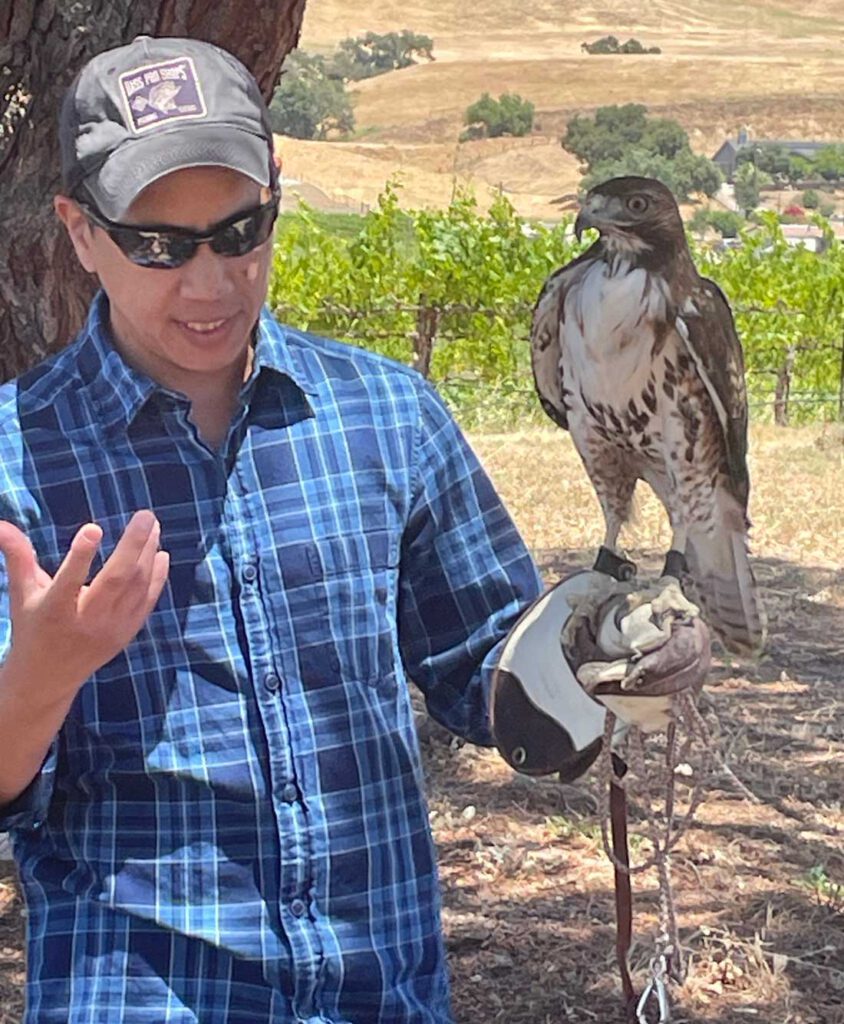
While living at Wheeler Ranch, he had a beautiful red-tailed hawk named Valentine, who Wong trained and put to work chasing birds away from the old vine grapes. He is currently training a female red-tail named Reckless.
Wong has worked with many raptors, but prefers red-tails.
“As a hunter, they are super powerful, like a Ferrari F1 car. They drop like a brick out of the sky,” said Wong. The females, which are 30% larger than males, can easily take out a large jackrabbit.
Wong’s knife obsession began with a Swiss pocket knife given to him by his grandfather who was in the Army at Fort Ord.
“Grandpa always had a knife and showed me how to throw,” said Wong. “With a strong military history, you learn how to take guns apart and clean them: same with knives. I still use a cleaver from my great grandfather’s butcher shop in Oakland.”
He makes a small number of knives each year, which can be purchased at the Folktale tasting room.
Ranch life
Currently living at regenerative farming and ranching experiment Paicines Ranch in Tres Pinos, Wong is still managing the vines at Calleri and Wheeler—with some of the grapes now going into Folktale’s wines.
Wong returned to Folktale after winemaker David Baird departed, and is currently helping owner Greg Ahn rework the historic property.
He’s also involved with another large vineyard project in Gonzales, driven by Ahn and his business partners, that will bring exciting new wines to the Folktale lineup—including Albarino and Gamay Noir.
For his own label, Blade & Talon, he’s planning to add Aligoté, Counoise, plus a Carignane blend, and might do a carbonic Negrette.
Wong also got involved in making wine for Paicines Ranch last year, and will likely make Cabernet Sauvignon and Cabernet Franc as a field blend from the certified regenerative vineyard, overseen by Kelly Mulville, who joined the ranch in 2014.
The unique vineyard is trellised high enough to be out of reach of the sheep, who perform weed control and add nourishment to the soil all year. Most other vineyards are trellised too low to allow anything but Baby Doll sheep, and they cannot be allowed in the vineyard after the shoots begin to form a canopy.
Paicines Ranch grows varieties like Assyrtiko, Barbera, Carignane, Ciliegiolo, Counoise, Fiano, Grenache Blanc, Grenache Gris, Grenache Noir, Mencia, Muscat Blanc, Nero d’Avola, Picpoul and Verdejo.
Fellow winemaker Ryan Stirm is tasked with making whites and a rosé for the Overlook wine brand produced by the Ranch. In addition to the organically farmed vineyard and row crop farm, the 7,000-acre Paicines Ranch raises livestock—including grassfed cattle and lambs, as well as pasture-raised pigs and turkeys—for purchase.
They also have a restaurant and lodging, and frequently hold seminars on regenerative agriculture. The Overlook restaurant offers lunch by reservation to the public on Thursdays, from 11:30am-1:30pm. They are also hosting a farm dinner on Aug. 15, beginning at 5:30pm.
The stunning landscape of Paicines Ranch extends over three dramatically deep and beautiful ravines, where cattle roam among native species.
Wong said San Benito County has the largest percentage of organic rangeland in California, and is also prime habitat for the San Joaquin kit fox.
“One of our neighbors runs about 15 to 25 head of Angus cattle here,” Wong said. “But his own ranch is like in The Lion King: everything the light touches. The family wants to keep it that way.”
Wong said the newest invention for bird abatement in the vineyard involves lasers that disrupt flocks of pesky starlings, a vineyard’s aerial menace, from descending on the vines and ruining the fruit. Not nearly as exciting as watching a red tail on the hunt, in swift pursuit.